
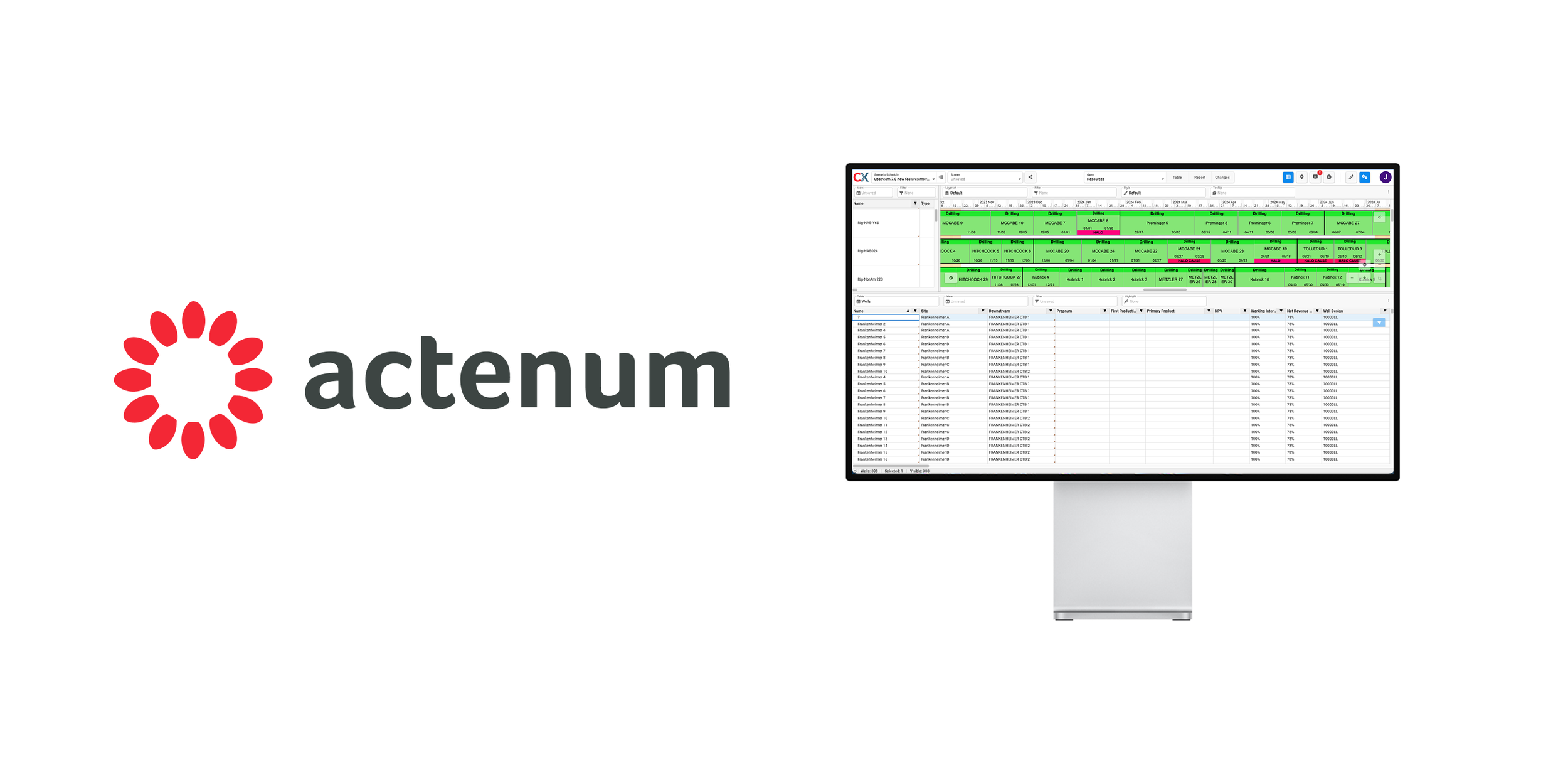
Timeline: 4 years
Category: UX & UI design
Type: Web App
Tools: Figma, Jira
Note: All CX images feature sample data and contain no actual customer information
Background & Overview
Extracting oil and natural gas requires the coordination of people, equipment, and industrial assets to bring petroleum resources out of the ground. Managing these operations involves complex scheduling, where delays or inefficiencies can cost millions of dollars in lost production and equipment downtime. Actenum builds enterprise software that helps major producers manage and optimize these high stakes schedules through two primary products: Decision Support Optimization Upstream (DSO Upstream) and Collaboration Exchange (CX).
DSO Upstream is built for master schedulers and is a highly complex system that houses and optimizes a company’s schedule. It requires extensive training and experience to use effectively. CX, by contrast, is designed to make scheduling information accessible to a broader group of users who need visibility into the schedule without the depth of configuration required in Upstream.
I joined Actenum in 2022 as the company’s first UX designer, with a primary focus on CX. Prior to my arrival, design decisions were largely driven by development needs, with limited use of mockups, structured user flows, or formal UX process. While the software was powerful, the experience had evolved without a cohesive user centred approach. My role was to establish a structured design practice and lead the evolution of CX into a more intuitive and user centred product.
The Challenge
My time at Actenum presented several distinct challenges that evolved over the course of nearly four years. When I joined in 2022, I was immediately tasked with contributing to a full redesign of the CX application. Following the redesign, my focus shifted to porting complex functionality from Upstream into CX, with the goal of simplifying and improving the experience for a broader audience of user. In parallel, I was responsible for designing new features driven by customer requests.
These responsibilities came with three primary challenges.
First, I entered the role with limited knowledge of the oil and gas industry and was tasked with designing software used by highly experienced schedulers and planners. The domain was complex, the terminology was specialized, and mistakes could have real consequences if not identified before development.
Second, I was the first designer at the company. The development and project management teams had never worked with a dedicated UX role, and I had not previously been in a position where I needed to define and establish design processes from the ground up.
Finally, access to end users was limited. Oil and gas schedulers operate under significant time pressure, which made frequent research and usability testing difficult. In addition, I am based in Vancouver while the majority of customer head offices are located in other cities around the world. I needed to find ways to build domain understanding and validate design decisions despite constrained and geographically distributed user access.
I was tasked with redesigning a complex enterprise product in an industry I knew little about while simultaneously building the company’s first formal design practice with limited user access.
Approach
My first step in addressing these challenges was research. Actenum recognized the complexity of both the oil and gas industry and its own software, and had compiled a library of videos and articles to support domain learning. I worked through this material and expanded my knowledge further by enrolling in free Stanford University courses that covered introductory oil and gas concepts.
At the same time, I needed to build an understanding of the product itself. Project managers and developers some with over 20 years at Actenum, dedicated time to walking me through the application, its underlying logic, and their long term vision for its evolution.
It also became clear early on that access to end users would be extremely limited. Moving from an empty plot of land to a fully operational drilling site is a complex and detailed process where efficiency can mean millions of dollars in savings. As a result, schedulers and planners rarely have spare time to participate in research. In addition, privacy constraints within oil and gas companies limited our visibility into real usage patterns. This created a significant challenge in understanding how schedulers interacted with CX and acquiring feedback on new designs.
To address this, I established a group of subject matter experts (SMEs) who were internal to Actenum to provide feedback based on their years of experience in the industry. Over time, several employees had joined Actenum after working as schedulers and had used our products in real world scenarios. They supported sales and onboarding efforts and had years of hands on experience using the software in real contexts. This group became my primary source for workflow validation, domain clarification, and iterative design feedback when direct user access was not possible.
The final piece was defining and embedding a structured design process within the development team. Drawing from my experience at Ritchie Bros., I introduced a weekly design review that included representatives from frontend, backend, QA, and project management. This helped establish early visibility into design decisions and began integrating UX into Actenum’s development process.
However, after several months, it became clear the group was too large. Meetings became lengthy, opinions were difficult to reconcile, and progress slowed. During this period, my role was formally integrated into the frontend team, which allowed for closer day to day collaboration with developers and my team lead.
We refined the review structure to include only one representative from each team. This smaller group significantly improved decision speed and clarity, leading to a more efficient workflow and increased feature output. Over time, I continued refining the process, shifting toward multiple asynchronous reviews each week. This allowed for continuous iteration and feedback before synchronous discussions, further increasing momentum.
I built domain expertise, established an SME feedback group, and embedded a structured design process to bring clarity and momentum to CX product development.
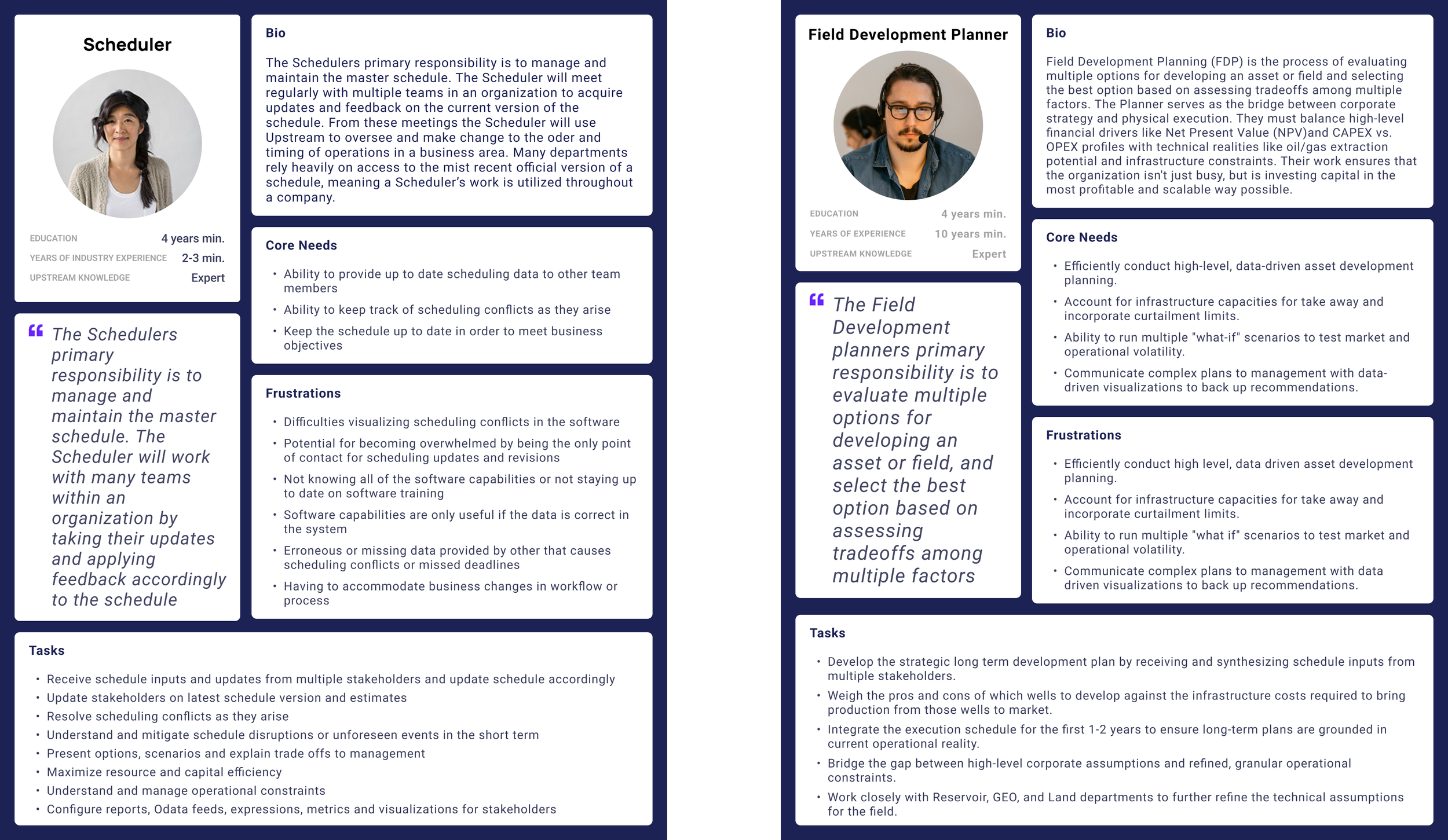
User Personas created after research
Design
With a defined process, stronger domain knowledge, and a reliable SME feedback group in place, I was able to approach the redesign of CX with the right structure for success.
When I began working on CX in 2022, the application had been shaped by a small team operating primarily under development priorities. It was highly data dense, with limited information architecture and missing features needed for the more collaboration oriented application CX was intended to be. While it had strong potential, it required significant familiarity with its larger counterpart, Upstream, to use effectively. New or occasional users often struggled to navigate workflows without guidance, and adoption reflected that. CX had relatively few active users, and customers were hesitant to expand licensing because its value was not immediately clear across broader teams.
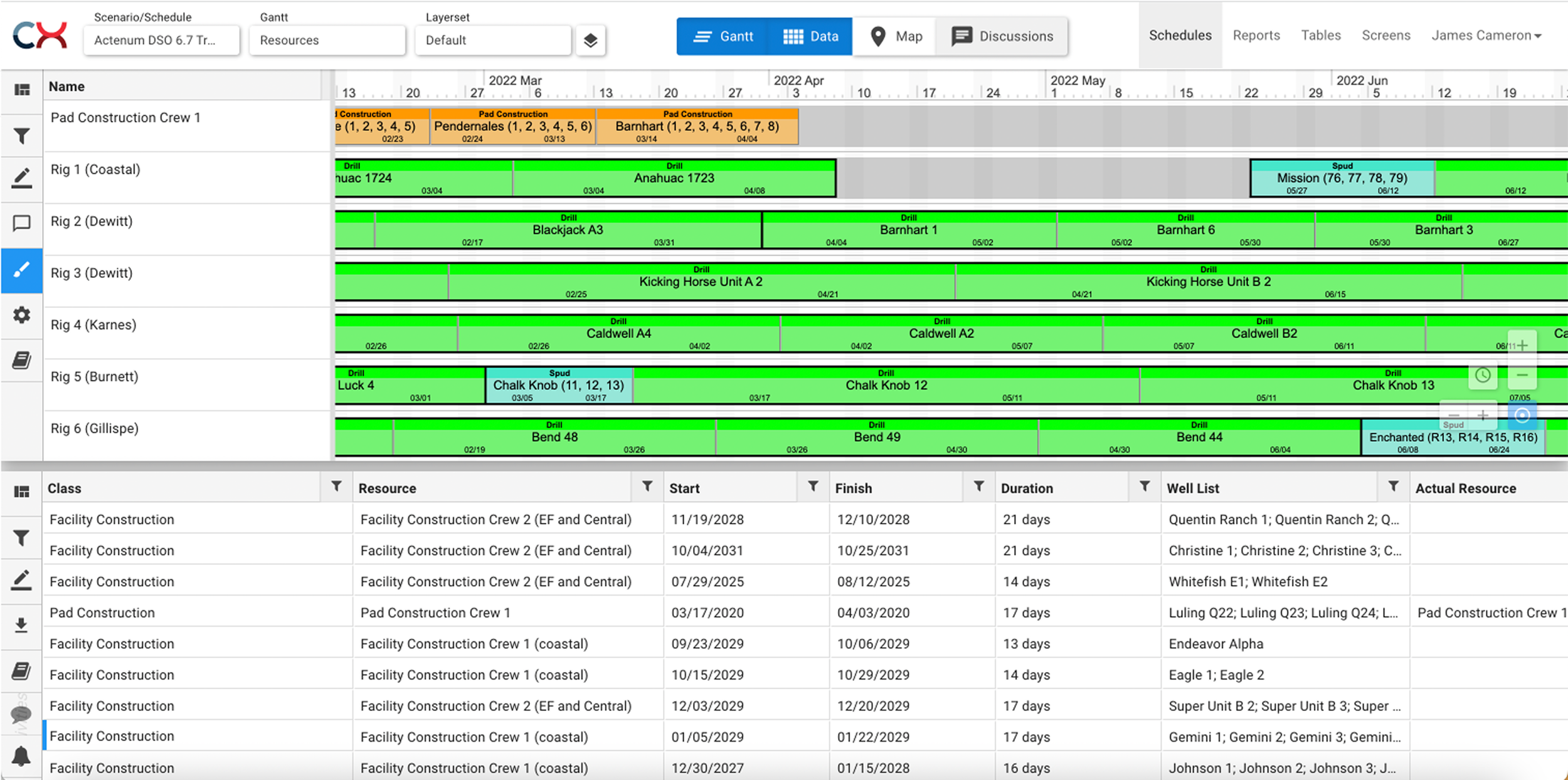
Original CX interface before redesign
The redesign focused first on structure. I overhauled the navigation and reorganized core controls to create a more intuitive foundation. A key part of this was addressing the original interface’s reliance on icons for configuration settings. This lacked visibility and forced users to memorize settings and what was currently applied. I transitioned these to clearly labeled menus that surfaced both the setting name and its current state, allowing users to understand the system configuration at a glance. By rethinking hierarchy and grouping related actions, I was able to reduce visual noise and introduce clearer interaction patterns. The goal was not to simplify by removing capability, but to make complex functionality easier to understand, more predictable, and more approachable.
A central challenge was balancing two user types: expert planners who spent the majority of their day in CX and Upstream, with occasional users who entered the system to make quick updates or review schedule information. I worked to ensure the interface remained efficient for power users while lowering cognitive load for occasional users completing focused tasks. Over time, features originally exclusive to DSO Upstream were introduced into CX, making it a more capable and valuable tool without overwhelming the interface.
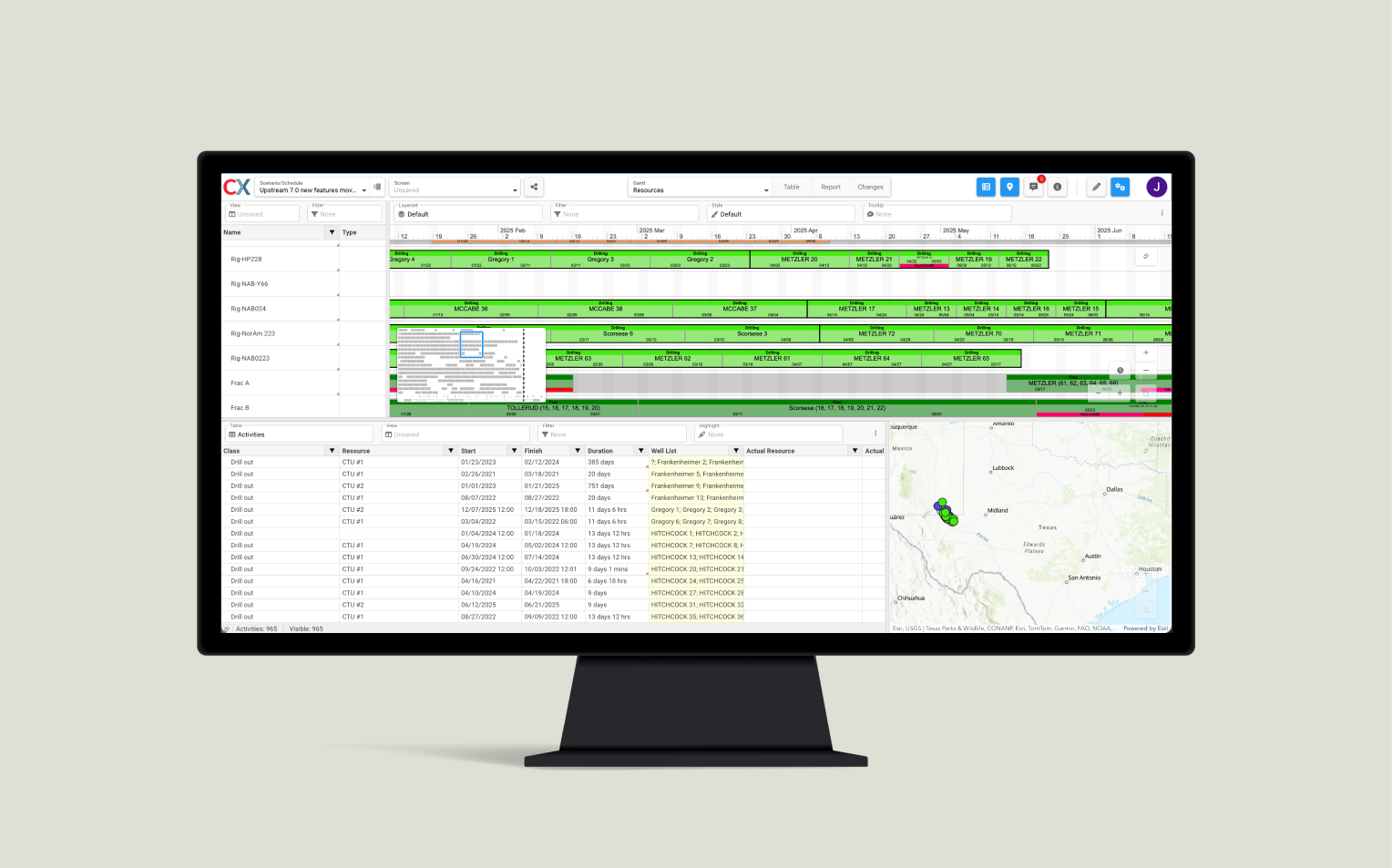
Redesign of CX
A turning point in my understanding came during an opportunity to visit a customer’s head office in Houston, Texas. This provided dedicated time to observe schedulers and planners in their real working environment. I conducted interviews across many roles, observed users interacting with CX at their desks, and saw firsthand where workflows broke down or felt unintuitive. I noticed non-expert users dragging panels (like the map or table) to 0px to hide them, making handles impossible to recover off the side of the screen, or attempting to edit data while 'Edit Mode' was toggled off.
This was a reminder that some users do not have the time or willingness to learn when they only need CX for quick or simple tasks. To assist them, I created an onboarding tutorial designed to quickly convey the basic controls. While this helped those willing to learn, I knew some users would still skip the tour and eventually find themselves stuck. To support those users, I designed a more passive guidance approach through system constraints. I established minimum panel widths and designed contextual triggers that surfaced temporary tooltips only when a user hit a constraint. These tooltips guided a user’s attention to the specific button or control they needed at that moment. This ensured that even if a user opted out of formal onboarding, the interface remained resilient. With this design I was able to transform potential errors into teaching moments. Onsite visits always serve as a clear reminder that what may seem like a simple design does not always translate to clarity in practice.
That in person experience significantly accelerated my domain understanding. Over time, relationships with several users strengthened to the point where they were willing to review early concepts, provide feedback on proposed features, and actively participate in improving the product. What began as limited access evolved into a relationship with shared excitement for sneak peeks and improvements to the software they used daily.
As CX matured, it became more than a lightweight companion to Upstream. It evolved into a product capable of supporting meaningful operational workflows without the steep learning curve associated with its counterpart Upstream. As functionality expanded and usability improved, the sales team began reporting stronger reception during demos and increased customer interest in expanding CX licenses. Support for tablets was added and the product was no longer seen as secondary, but as an accessible and practical extension of the Actenum ecosystem.
With the right tools in place, I led the redesign for CX that clarified information architecture and made CX accessible to non expert users without sacrificing efficiency for power users.
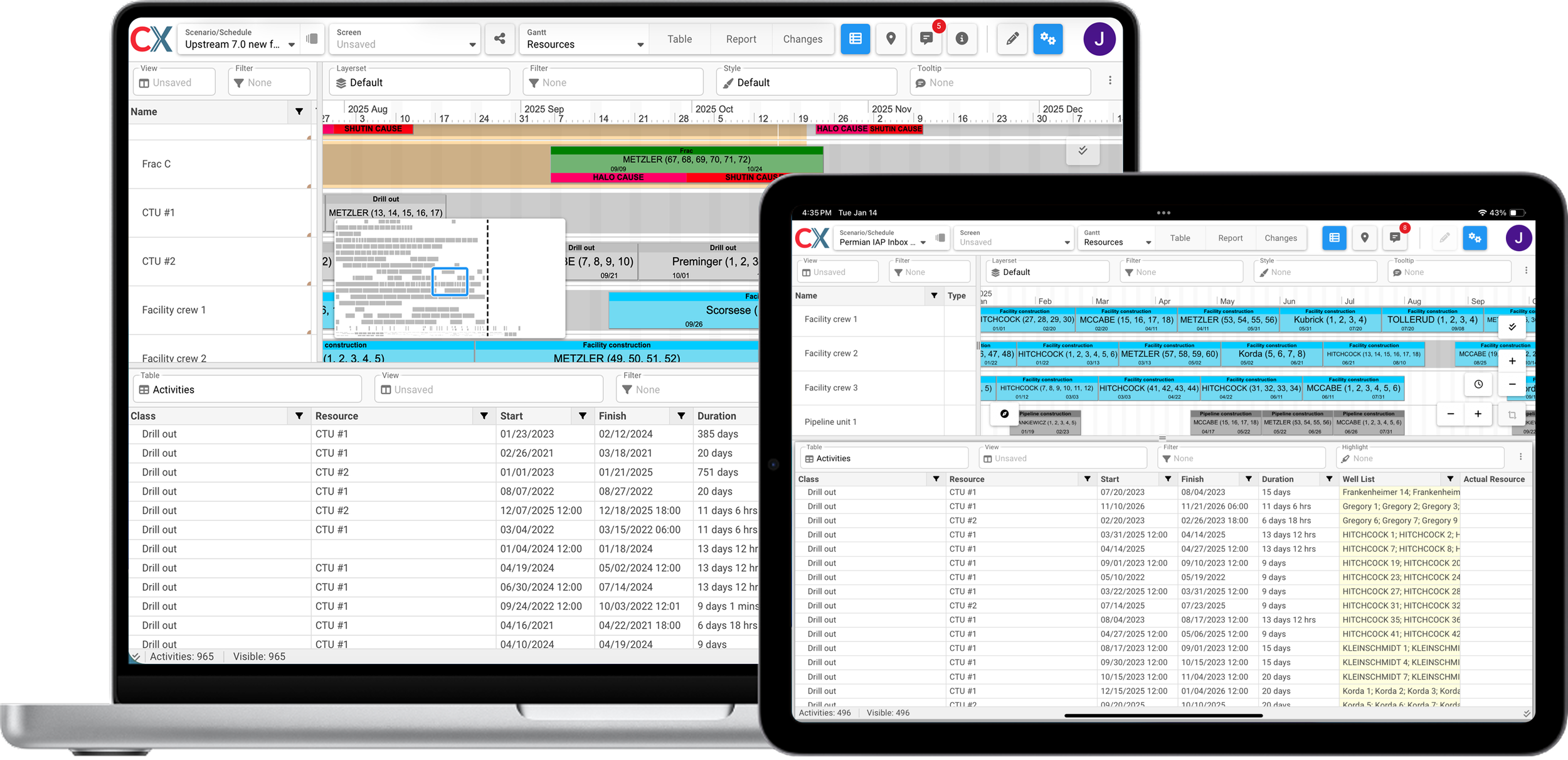
CX redesign for both desktop and tablet
Impact
Across four years, the work was iterative rather than singular. CX did not change overnight. Instead, it improved release by release: clearer workflows, more consistent interaction patterns, expanded functionality, and a more approachable experience. During this period, the development team also transitioned the product from an on premise architecture to a SaaS model. This shift dramatically increased the product’s ability to evolve, enabling smoother upgrades, and more continuous improvement.
As CX absorbed more core capabilities and benefited from a modern delivery model, it began to represent a long term strategic direction for the product line. With continued iteration and design vision, CX had the potential to not only complement Upstream, but eventually succeed it one day, offering comparable capability in a system that was significantly more modern, maintainable, and adaptable.
The result was a product that grew in capability while becoming easier to understand, easier to navigate, and more broadly adopted within customer organizations.
My Takeaway from Actenum
In the oil and gas industry, efficiency is directly tied to financial impact. A single day lost due to scheduling inefficiencies or errors can represent millions of dollars in lost production, labor costs, and equipment rentals. While CX was one piece of a much larger operational system, I am proud of the role I played in improving the software used to manage these schedules. Making CX usable with minimal training allowed organizations to extend access beyond a small group of experts, increasing schedule access and improve overall effectiveness.
By introducing a structured design process grounded in research, SME collaboration and user feedback, design became a core part of product development at Actenum. Output increased in both volume and quality, and decisions were no longer purely feature driven. They were informed by usability, workflow efficiency, and a deliberate focus on user needs before development began.
The changes to CX directly influenced adoption and customer perception. As usability improved and functionality expanded, customers reported greater value from the product. Colleagues shared that users were genuinely excited about new features and enhancements, a notable shift from the earlier reluctance around engagement.
On a personal level, this experience reshaped my confidence as a designer. I built a functioning design process from scratch within a growing organization. I learned how to understand complex enterprise software in a domain I initially knew nothing about, with limited direct user access. I proved to myself that I could operate as the sole designer in a company. Setting direction, raising standards, and continuously improving both the product and my own capabilities.
My time at Actenum clarified the trajectory I want for my career: designing complex B2B enterprise software where usability, clarity, and efficiency are central to success. CX was the next stride forward in my growth into a user centred enterprise designer.